Community
Community
NEWS
총 971건의 게시물이 있습니다.
There are a total of 971 posts.
-
News
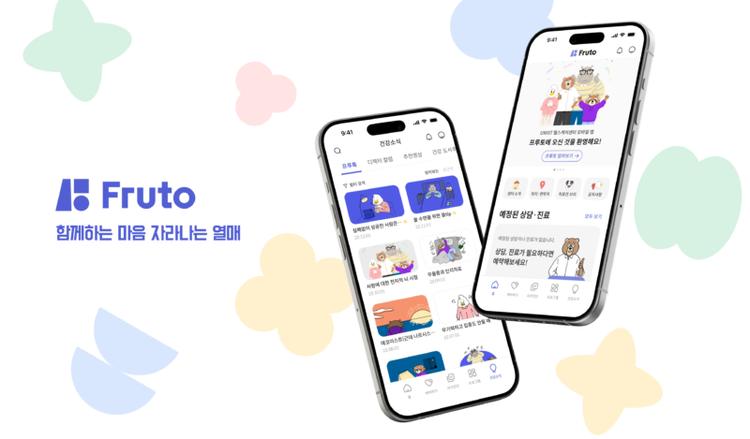
UNIST Launches New Mobile Platform to Support Campus Health and Well-BeingNew digital platform brings healthcare services, counseling, and self-screening tools together in one place.JooHyeon HeoUNIST has launched Fruto, a mobile health platform designed to improve access to campus healthcare services while supporting the physical and mental well-being of the university community. Developed by the UNIST Healthcare Center, the platform brings together healthcare information, counseling services, medical appointments, self-screening tools, and wellness programs within a single, user-friendly interface. Introduced in September 2024, Fruto was created to help students, faculty, and staff access health resources more conveniently while encouraging proactive health management. By integrating essential healthcare services into one platform, the app enables users to seek information, schedule appointments, complete self-assessments, and connect with professional support whenever needed. The name Fruto—the Spanish word for fruit—reflects the idea that good health is the foundation from which academic achievement, research, and personal growth can flourish. Just as fruit is the product of careful cultivation, the platform was designed to help members of the UNIST community develop healthy habits that support both their well-being and their pursuit of excellence. Fruto was developed through a collaboration between Professor Dooyoung Jung of the Graduate School of Health Science and Technology, Professor Hwang Kim of the Department of Design at UNIST, and the UNIST Healthcare Center. Throughout the development process, undergraduate students participated in perception surveys, UI/UX planning, and collaborative design workshops, ensuring that user needs and experiences shaped the platform from the earliest stages. The platform offers a wide range of integrated services, including access to Healthcare Center information, counseling and medical appointments, self-screening tools, wellness program registration, and the latest health-related news. While most informational features are available to the general public, appointment requests for Healthcare Center services are reserved for UNIST members. Within two months of its launch, Fruto had attracted more than 400 registered users, with early feedback highlighting the convenience of accessing counseling services and self-screening tools through a single mobile platform. "Fruto represents the culmination of our efforts to make healthcare services more accessible to our campus community," said Yu Geyong Lee, a clinical psychologist at the UNIST Healthcare Center who participated in the platform's development. "By providing a centralized communication channel, the platform enables users to access reliable health information and connect more easily with healthcare professionals." Professor Kim emphasized the importance of close collaboration between the design research team and the UNIST Healthcare Center throughout the project. "Fruto is designed as an integrated healthcare platform that can continue to evolve alongside the needs of the UNIST community," he said. "Its development demonstrates the value of participatory design, where users actively contribute to creating services that are both practical and meaningful." Professor Jung noted that university students—particularly those studying science and engineering—often face significant mental health challenges while balancing demanding academic environments. "Our goal is to create an environment where members of the UNIST community can take a more proactive approach to their well-being," he said. "By supporting early identification of health concerns and making professional services easier to access, we hope Fruto will encourage healthier and more resilient campus life." Fruto can be accessed through its official website or downloaded by scanning the QR code provided by the UNIST Healthcare Center. Beyond the platform itself, the UNIST Healthcare Center provides integrated medical, counseling, family medicine, and psychiatric services to support the physical and mental health of the campus community. Looking ahead, the center plans to further strengthen its digital health management system while expanding integration with campus counseling services.- 2024.11.19
- 1104
-
News
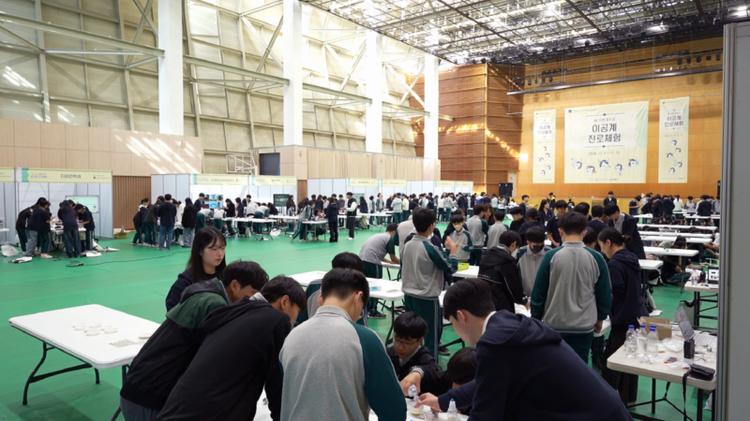
Successful Completion of 10th Ulju County Science and Engineering Career Experience CampThe 10th Ulju County Science and Engineering Career Experience Camp from November 7 to 15, 2024.JooHyeon HeoThe UNIST Leadership Center proudly hosted the 10th Ulju County Science and Engineering Career Experience Camp from November 7 to 15, 2024. This annual event aims to inspire local middle school students by offering them a unique opportunity to explore potential careers in the fields of science and engineering, with support from UNIST and Ulju County. A student mentor is detailing the experimental procedures involved in Energy and Chemical Engineering. | Image Credit: UNIST Leadership Center This year's event brought together 95 UNIST student mentors and approximately 2,000 middle school students from 14 different schools in Ulju County. The mentors introduced their academic majors and shared their passion for science and engineering through a series of engaging career experience programs. Students also had the chance to participate in hands-on activities at 18 experience booths operated by 16 different departments, exploring various scientific principles in areas, such as mechanical engineering and biomedical engineering. This immersive experience was designed to spark excitement and curiosity about the sciences. Students are engaged in hands-on experiments at the event. | Image Credit: UNIST Leadership Center During campus tours, students explored UNIST's advanced research facilities, including the UNIST Seawater Resources Technology Research Center. This valuable exposure allowed them to observe scientists in action, experiencing firsthand the cutting-edge research taking place at the university. Feedback from participants was overwhelmingly positive. One student remarked, "I became interested in science by experiencing experiments that I couldn't learn in school," while another added, "It made me seriously consider my future career." SangEon Park, a mentor from the Department of Electrical Engineering at UNIST, expressed his fulfillment, stating, "I felt rewarded to provide academic inspiration to my juniors." A representative from the UNIST Leadership Center emphasized the institution's commitment to fostering interest in science among students. "UNIST will serve as a strong supporter in helping students cultivate their interest in science and develop their dreams," the official stated. "We will continue to promote various educational programs that grow alongside the local community in collaboration with Ulju County."- 2024.11.18
- 5997
-
News
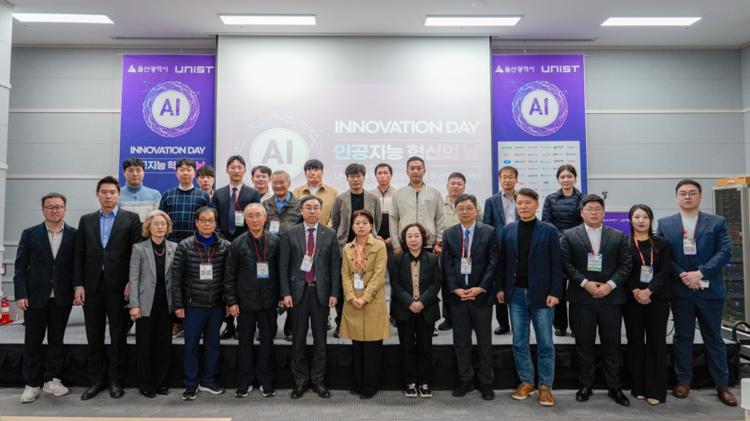
UNIST AI Innovation Park Hosts Successful 2024 AI Innovation Day at WAVE 2024!The 2024 AI Innovation Day took place at the Ulsan Exhibition & Convention Center (UECO) on November 6, 2024.JooHyeon HeoOn Wednesday, November 6, the UNIST AI Innovation Park proudly hosted the 2024 AI Innovation Day at the Ulsan Exhibition & Convention Center (UECO). The primary goal of this event is to accelerate the integration of artificial intelligence (AI) within local industries, while showcasing the innovative achievements spearheaded by UNIST. Held concurrently with WAVE 2024, the event drew considerable attention, attracting over 100 attendees, including officials from AI-related companies, researchers, and students. Participants engaged in lively discussions across diverse fields, emphasizing the collaborative spirit of innovation. In his welcoming speech, Vice President Sung Chul Bae of Academic Affairs at UNIST is delivering a welcome speech for the event. In his welcoming speech, Vice President Sung Chul Bae of Academic Affairs at UNIST remarked, "AI Innovation Day serves as an invaluable platform for sharing the accomplishments of the UNIST AI Innovation Park with local industries and for exploring future development pathways." The event featured a variety of research presentations from the AI Novartus Academy and associated AI tenant companies. Unveiling numerous initiatives—including AI talent development, corporate support, and R&D—the UNIST AI Innovation Park reinforced its role as a pivotal innovation hub dedicated to fostering AI adoption among local enterprises. Director Seungjun Yang of UNIST AI Innovation Park is delivering a congratulatory remark at the 2024 AI Innovation Day on November 6, 2024. Director Seungjun Yang UNIST's AI Innovation Park, noted, "Since our establishment in 2021, the AI Innovation Park has emerged as a central hub for collaboration between academia and the AI industry in Ulsan and the surrounding southeastern region." He further added, "We are dedicated to enhancing the competitiveness of local industries while cultivating new sectors through our educational programs, research endeavors, and startup support." Meanwhile, the AI Innovation Park is transforming the industrial landscape by facilitating the adoption of AI technologies throughout Ulsan and its neighboring areas. This year, the AI Novatus Academy, an ongoing educational program, successfully trained 221 graduates from 113 companies, including prominent organizations such as HD Hyundai Heavy Industries Co., Ltd. and HD Hyundai Mipo Dockyard (HMD). Graduates have reported high satisfaction levels, attributing their success to the tailored educational programs that significantly boost industrial competitiveness.- 2024.11.07
- 635
-
News
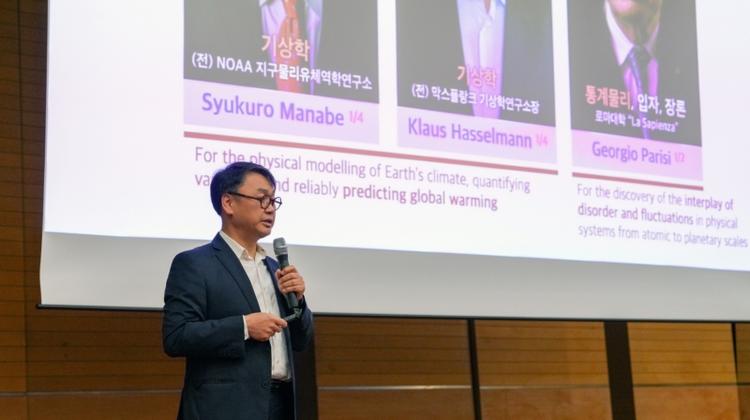
Successful Completion of 2024 Nobel Prize in Physics Commentary LectureThe 2024 Nobel Prize in Physics Commentary Lecture was held in the auditorium, featuring an engaging discussion on the convergence of AI and physics.JooHyeon HeoThe recent decision by the Nobel Committee marks a significant milestone in the recognition of 'information' as a fundamental aspect of reality within physics. This reflects the zeitgeist of our era, as physics increasingly aims to understand life and social phenomena through the lens of 'information,' transcending traditional material concerns. On November 1, the 2024 Nobel Prize in Physics Commentary Lecture was held in the auditorium, featuring an engaging discussion on the convergence of artificial intelligence (AI) and physics. Professor Cheol-Min Ghim from the Department of Physics at UNIST delivered the lecture, exploring the past, present, and future of AI while highlighting the groundbreaking contributions of Professor John Hopfield and Professor Geoffrey Hinton, this year's Nobel laureates in Physics. The event attracted an audience of over 230 participants, including more than 80 parents and local citizens accompanied by their children, demonstrating a keen interest in the sciences. Professor Ghim remarked, "This lecture was designed to examine the imminent future of the interaction between AI and physics," and further expressed, "I hope it provides an opportunity for citizens and aspiring scientists to engage thoughtfully with the impact of innovative technologies on society." Professor Ghim elaborated on the profound influence of the research conducted by Professors Hopfield and Hinton on AI development. Hopfield invented the Hopfield Network, which established a framework for the retention and association of information. Hinton has significantly advanced AI's learning capabilities through innovations such as the Boltzmann machine and backpropagation algorithms. Professor Ghim emphasized, "Without their pioneering work, today's artificial intelligence would not exist." Following the lecture, an interactive Q&A session ensued. When asked, "Does artificial intelligence have the potential to surpass human intelligence?" Professor Ghim responded, "AI possesses significant technological potential, but this must be accompanied by ethical responsibility." Attendees expressed positive feedback regarding the commentary lecture. Woo Jun-ha, a third grader at Eonyang Middle School, remarked, "It was fascinating to learn about the connection between AI and physics for the first time." Kim Bum-soo and Jeon Ju-hyuk, second graders at Shinjeong High School, added, "The links between physics and AI were remarkable, and today’s lecture provided us with valuable insights to enhance our school learning." Professor Ghim emphasized, "This lecture showcased the potential for further advancements in AI through the principles of physics." Participants left with renewed perspectives on the future of AI and its wide-ranging applications. President Chong Rae Park commented, "This lecture was an essential opportunity to understand the evolution of modern science through the convergence of artificial intelligence and physics. UNIST is committed to further fostering these academic exchanges." The Department of Physics is dedicated to continuing to provide opportunities for community engagement, promoting awareness and understanding of scientific advancements.- 2024.11.05
- 421
-
News
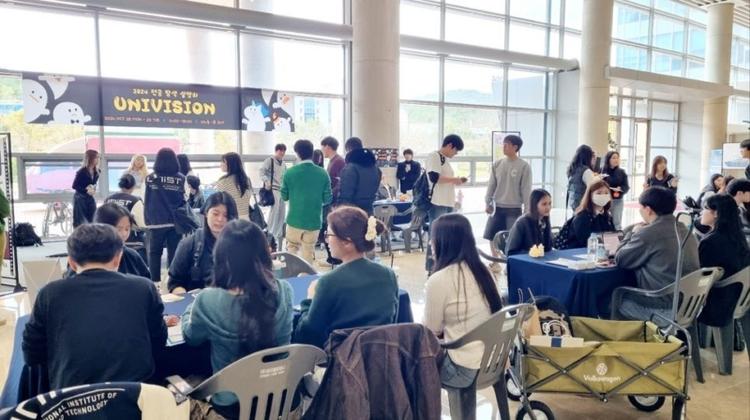
"2024 UNIVISION: A Comprehensive A to Z Guide to Major Selection from Senior MentorsJooHyeon HeoThe '2024 UNIVISION' event took place in the lobby of the Engineering Building II from October 28 to 29, providing an invaluable opportunity for freshmen to explore potential majors. UNIVISION is designed to offer up-to-date information about various departments, helping freshmen who enter without declared majors find options that align with their interests and aptitudes. Hosted by the freshman department, the event saw participation from approximately 200 students, who received practical guidance for their career design. Over 200 freshmen participated in the event, searching for majors that align with their interests and aptitudes. | Image Credit: School of New UNISTars In contrast to the professor-centered major exploration briefings held during the first semester, this year's UNIVISION adopted a Q&A format, enabling senior students from each department to operate booths and directly address questions from their juniors. Notably, graduate students also participated, sharing their specific experiences related to laboratory life and offering realistic advice, which significantly engaged the new students. Senior mentors shared their concrete experiences of university life, drawing significant attention. | Image Credit: School of New UNISTars With insights from these senior mentors, freshmen were able to establish criteria for selecting the department that best fits their aspirations. This event was particularly timely, offering students a chance to alleviate concerns about their major ahead of the upcoming major selection period scheduled for November 25-29, 2024. The Freshman Student Council also prepared events, like a ticket raffle, adding fun to the event. | Photo: Freshman Department. l Image Credit: School of New UNISTars The freshman student council enhanced the event’s festive atmosphere by organizing a series of engaging activities in anticipation of Halloween. Attendees had the chance to collect booth exploration stamps, participate in a ticket draw, and enjoy themed treats, creating a lively environment for learning about different departments and majors. Cheol-Min Ghim, Head of the School of New UNISTars, expressed his hopes for the event, stating, "I hope that new students who are nearing the decision-making process regarding their majors can satisfy their curiosity and uncover a path that truly suits them through the vivid experiences shared by their seniors. I would also like to extend my gratitude to each department and the student council for their support in making this event a success." Meanwhile, the freshman department continues to implement various programs aimed at helping new students adjust smoothly to college life and make informed career decisions.- 2024.10.30
- 7330
-
News
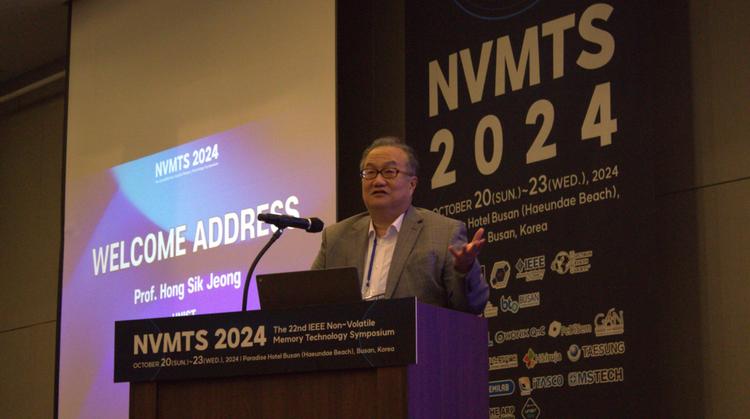
UNIST Collaborates with Global Experts to Advance Next-Generation Semiconductor TechnologyOrganized by the UNIST Graduate School of Semiconductors Materials and Devices Engineering, the NVMTS 2024 took place at Paradise Hotel Busan from October 20 to 23, 2024.JooHyeon HeoUNIST has collaborated with domestic and international experts alongside the Institute of Electrical and Electronics Engineers (IEEE), the Electron Devices Society (EDS), and the Korean Society of Semiconductor and Display Technology (KSDT) to advance next-generation semiconductor technology. Organized by the UNIST Graduate School of Semiconductors Materials and Devices Engineering, the 22nd Non-Volatile Memory Technology Symposium (NVMTS 2024) took place at Paradise Hotel Busan from October 20 to 23, 2024. This event gathered experts from around the world to discuss the future of semiconductor technology. Image Credit: Homepage of NVMTS 2024 The conference featured 35 international speakers and attracted over 250 attendees, including scholars and industry professionals from leading companies, such as Samsung Electronics, SK Hynix, and Micron Technology. Presentations focused on next-generation semiconductor devices, including Flash, MRAM, PCRAM, RRAM, and FeRAM, and highlighted innovative processes and system applications designed to enhance memory speed and efficiency. Participants of NVMTS 2024 had the opportunity to experience the latest advancements in semiconductor technology at various corporate booths. Additionally, a poster session showcased research findings from students specializing in related fields, fostering vibrant discussions and the exchange of ideas among future leaders. The NVMTS 2024 took place from October 20 to 23, 2024. l Image Credit: Graduate School of Semiconductors Materials and Devices Engineering, UNIST In his welcoming remarks, Professor Hongsik Jeong of the Graduate School of Semiconductors Materials and Devices Engineering at UNIST addressed the technical challenges currently facing the memory industry. "In today’s memory sector, Moore's Law—the principle that semiconductor performance doubles at regular intervals—has reached its limits," he stated. "This conference serves as a platform to address these challenges through new non-volatile memory technologies, drawing from cutting-edge research in both academia and industry."- 2024.10.28
- 1058
-
News
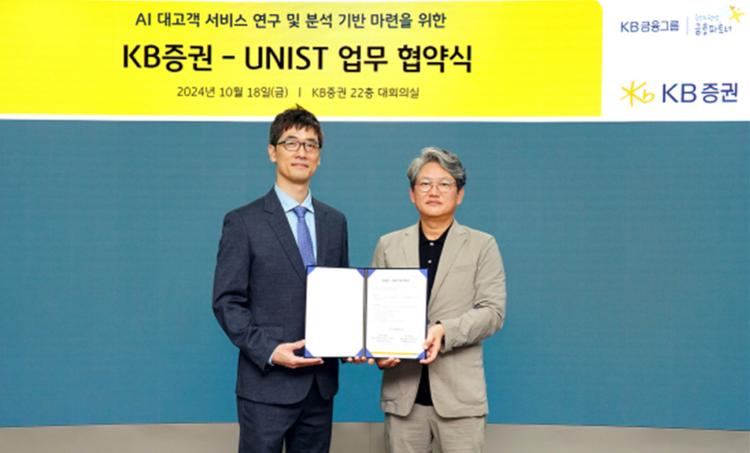
UNIST and KB Securities Forge Agreement to Pioneer AI Innovations Reshaping FinanceThe signing ceremony for the MoU betweenUNIST and KB Securities Co., Ltd. took place on October 18, 2024.JooHyeon HeoAs artificial intelligence (AI) is significantly transforming the financial services landscape, the Department of Industrial Engineering at UNIST has embarked on a groundbreaking collaboration with KB Securities Co., Ltd. to advance innovation in this domain. On October 18, UNIST and KB Securities Co., Ltd. formalized their partnership by signing a business agreement at the Yeouido Head Office of KB Securities. This strategic partnership is designed to establish a foundation for the research and analysis of AI-driven customer service. Through this collaboration, the two organizations will endeavor to develop investment propensity indicators, investment asset classification models, and enhance customer service by leveraging financial AI. Under this agreement, Professor Yongjae Lee in the Department of Industrial Engineering at UNIST will collaborate closely with KB Securities to identify personalized investor propensity indicators and conduct comprehensive research on the classification of stocks and funds. The ultimate aim is to create a robust technical infrastructure that facilitates the provision of customized financial services. "We will develop innovative services by expanding our AI research within the financial sector, capitalizing on our exceptional research capabilities," stated Sungil Kim, Head of the Department of Industrial Engineering at UNIST. "Through our financial AI initiatives, we will deliver differentiated customer services and lead the charge in financial AI innovation by crafting a hyper-personalized AI business model," added Woo-Sung Ha, Head of KB Securities' Digital Business Division. "This endeavor will transcend traditional industry-academia projects," said Professor Yongjae Lee, who will lead the joint research initiative. "Our focus is on revitalizing AI research and development within the financial industry through sustained, long-term collaboration." In the wake of this agreement, both organizations are poised to deepen their cooperation across multiple domains, including joint research on cutting-edge AI technologies, the identification of best practices, and the cultivation of talent in science and technology. Moreover, KB Securities Co., Ltd. will take on the role of principal sponsor for the '4th UNIST-KAIST-POSTECH AI & Data Science Contest,' hosted by the Department of Industrial Engineering at UNIST this year.- 2024.10.26
- 1504
-
News
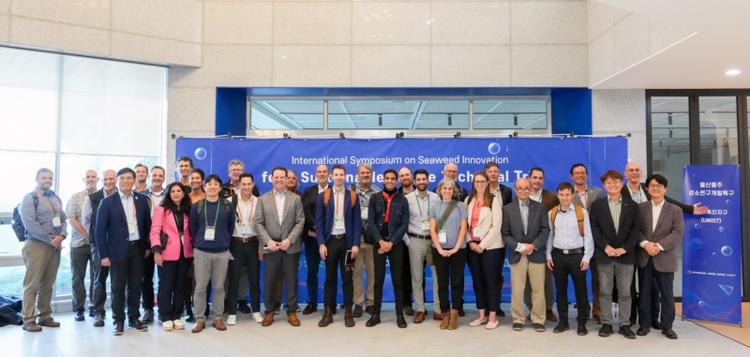
ARPA-E from U.S. DOE Visits UNIST to Enhance Collaboration on Seawater Resource TechnologyARPA-E's delegation visited UNIST, emphasizing international collaboration in seawater resource technology and Ulsan's energy industry.JooHyeon HeoThe Advanced Research Projects Agency-Energy (ARPA-E) under the U.S. Department of Energy (DOE) recently visited UNIST, underscoring the importance of international collaboration in the development of seawater resource technology and the growth of the energy industry in Ulsan. On October 23, UNIST welcomed a delegation from ARPA-E to discuss advancements in seawater resource technology. Approximately 30 participants, including officials from the U.S. Department of Energy and representatives from various energy companies, engaged in fruitful discussions during the visit, which followed a similar engagement at POSTECH. ARPA-E is dedicated to promoting and funding research and development (R&D) in advanced energy technologies. During their visit, the delegation toured the UNIST Seawater Resources Technology Research Center and attended presentations from companies in the Ulsan Ulju Innotown that are focused on developing seawater-based secondary batteries and related technologies. The discussions centered around potential collaborations in various areas, including seawater-based secondary batteries, hydrogen production, and carbon capture and storage. The UNIST Seawater Resources Technology Research Center has achieved a significant milestone by developing the world's first "Seawater Battery," which utilizes seawater as an alternative to the anode in lithium-ion batteries. Companies leveraging this groundbreaking technology are co-located within the center to facilitate commercialization efforts. Seawater batteries are gaining attention as an environmentally friendly and cost-effective energy storage solution. Simon Freeman, Program Director of ARPA-E stated, "During our visit to the UNIST Marine Resource Center, we were impressed by the remarkable progress and practical potential of seawater cell development over the past decade. We are considering seawater cells as viable candidates for energy sources in marine applications and look forward to collaborating with national research institutions and universities in the United States." Youngsik Kim, Director of the Ulsan Ulju Innotown, remarked, "ARPA-E has demonstrated a strong interest in both UNIST and the research on seawater cells being conducted in Ulsan." He added, "We intend to foster close relationships to enhance international cooperation among companies within the special zone."- 2024.10.23
- 2734
-
News
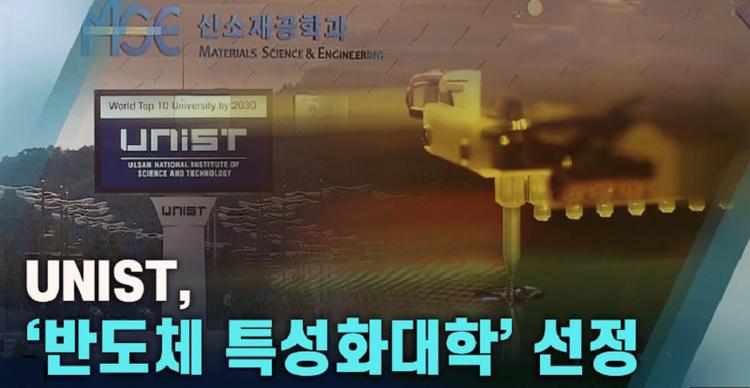
UNIST Selected for ‘Semiconductor Specialization University Support Project’!With this selection, UNIST will receive a substantial sum of KRW 15 billion in support over the next four years.JooHyeon HeoUNIST is set to receive a total of 15 billion won over the next four years, composed of national, local, and response funds, to advance its efforts in cultivating professional talents for the semiconductor industry. The Ministry of Education has announced that it has selected UNIST for the '2024 Semiconductor Specialized University Support Project,' granting the institution 15 billion won (14 billion won from the national funds and 1 billion won from the local budget). This funding will enable UNIST to further expand its academic programs and establish a comprehensive system for nurturing full-time professionals in the semiconductor sector. Launched in 2023, the 'Semiconductor Specialized University Support Project' aims to create a robust training system and modern facilities for developing skilled professionals who meet industry demands. The initiative encompasses both singular and shared growth models, targeting institutions in metropolitan and non-metropolitan areas. UNIST was ultimately selected through a competitive re-public offering as a recipient for the non-metropolitan category. In 2021, UNIST established the Graduate School of Semiconductors Materials and Devices Engineering, and in 2023, it was selected for the 'Semiconductor Specialization Graduate School Support Project' in 2023 by the Ministry of Trade, Industry, and Energy (MOTIE), producing an impressive 65 skilled talents each year. Over the next four years, UNIST plans to train 220 skilled professionals in essential areas, such as materials, devices, processes, and packaging. Five departments, including the Department of New Materials Engineering, will collaborate to establish a "Semiconductor Specialized Convergence Major," which will feature an industry-academia linked curriculum that includes intensive lectures, hands-on projects, and industrial practice. The funds from the national budget will be allocated for faculty salaries, the construction of research facilities, the acquisition of research equipment, and curriculum development. Additionally, Ulsan Metropolitan City will contribute 1 billion won over three years starting in 2025 to support semiconductor talent cultivation. UNIST is committed to producing professionals who can be immediately deployed to research and development sites. Students will take the lead in researching core semiconductor technologies, deepening their understanding, and receiving systematic training that fosters collaboration with industry partners, ultimately preparing them as capable practitioners. "We will systematically cultivate practical talents who will lead the future of the semiconductor industry," said Professor Soo-Hyun Kim, Head of the initiative and a faculty member in the Department of New Materials Engineering. "Our focus will be on innovative education and research to enhance our position in the global competitive landscape." As semiconductors are integral to a wide array of technology sectors, from everyday applications to advanced industries, the demand for skilled professionals in this field is rapidly increasing. UNIST's selection for this project is expected to significantly contribute to strengthening semiconductor competitiveness both regionally and nationally.- 2024.10.23
- 4898
-
News
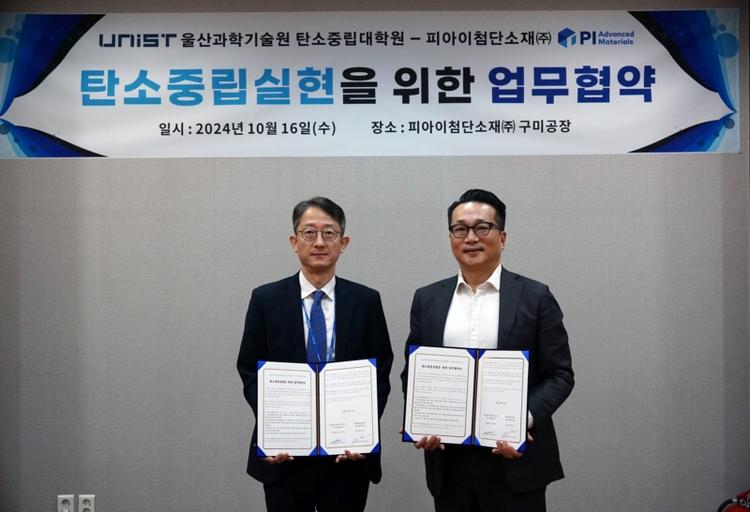
UNIST Signs Cooperation MoU with PI Advanced Materials Co., Ltd.The signing ceremony for the MoU between the Graduate School of Carbon Neutrality and PI Advanced Materials Co., Ltd. took place on October 16, 2024.JooHyeon HeoUNIST Graduate School of Carbon Neutrality will work with PI Advanced Materials Co., Ltd., the world's largest polyimide film market share, to develop technology to reduce carbon emissions. On October 16, the Graduate School of Carbon Neutrality and PI Advanced Materials Co., Ltd. entered into a business agreement to realize carbon neutrality. The two organizations worked together in various fields, including the development of carbon neutrality policies, joint research, and human resources development, aiming to commercialize carbon neutrality technology. The Graduate School of Carbon Neutrality at UNIST currently operates four research groups: △ Environmental Management and Policy Research △ Carbon dioxide capture, utilization, and storage (CCUS) technology △ Hydrogen and renewable energy technology. Based on its research capabilities, it plans to accelerate technology development in cooperation with PI advanced materials and actively apply research results to industrial sites. The two organizations plan to combine carbon-neutral technology with advanced materials to lead environmental issues and innovation. They plan to strengthen their global competitiveness by consolidating policy and technological cooperation and strive to realize carbon neutrality. "Cooperation with PI Advanced Materials Co., Ltd. will be an important milestone in the commercialization and research of carbon neutral technology," said Yongwon Seo, Head of Graduate School of Carbon Neutrality. "We hope that concrete results will be achieved starting with the agreement and that we will lead to a big change for a sustainable future." "Through cooperation with UNIST, we will strengthen policy and technological cooperation to realize carbon neutrality, which will mark a new turning point in achieving corporate carbon neutrality goals," said Heejoon Ham, Senior Vice President of PI Advanced Materials Co., Ltd. "We expect each other to grow in various aspects such as policy development, technological innovation, and talent training."- 2024.10.18
- 1604